Quadratic Coasters
Using mathematical modeling in roller coaster design
Contributors: Katherine Harris, Brittney Miller, Shonda Kuiper, Tyler George, Yueran (Sarah) Qi' 27
Part 1A: Introduction
Have you ever wondered what goes into designing a thrilling roller coaster? For example, have you ever experienced that rush of adrenaline as you plummet down a steep drop or twist through a high-speed turn? What makes certain roller coasters stand out from the rest—are they designed with specific elements to maximize excitement?
When we consider more abstract mathematical functions in real-world applications, we are engaged in the process of mathematical modeling . In this lab, we will explore how we can use different types of functions to create models of roller coasters to analyze, and how mathematical tools can help us design better models.
The video below demonstrates how to play the roller coaster game using only quadratic equations.
VIDEO
Part 1B: Designing a Coaster
Your aim is to create a smooth enter a smooth and continuous function that represents the most exciting roller coaster possible. The final score represents the level of excitement, which is measured by the total changes in elevation of your coaster.
Goal: Create a coaster with the most vertical distance travelled.
Base Rules:
Enter at least one equation.
The coaster must start at (x=0, y=0) and end at (x = 50, any y).
The maximum y value is 500.
For every equation, y must be 0 or higher.
Going up the first hill does not count towards your score.
Complete the following steps to play the coaster game:
Player ID: You can use any name you like, but please note that it will be visible on the internet. Use a code name that you will remember, but do not use a name that will easily identify you.Group ID: You can use any name you like. However, if you are playing this game for a course, use the exact Group ID provided by your instructor, which is the same for every person in the class.Click the Play button.
Select Level 1 and enter your roller coaster functions.
Watch the video or read Part 1C and Part 1D for sample equations.
The track (the mathematical equations you enter) must flow smoothly without any breaks or sharp turns. You may find it helpful to use a graphing tool, such as Desmos , to explore different functions that can be used in your roller coaster design.
NOTE: If you are unable to play the game, try using a different browser or visit the game website directly Here .
Part 1C: Example - Linear Coasters
Let's first start with linear models to get comfortable with the game. You'll recall that a linear function has the algebraic form
f(x) = a + bx.
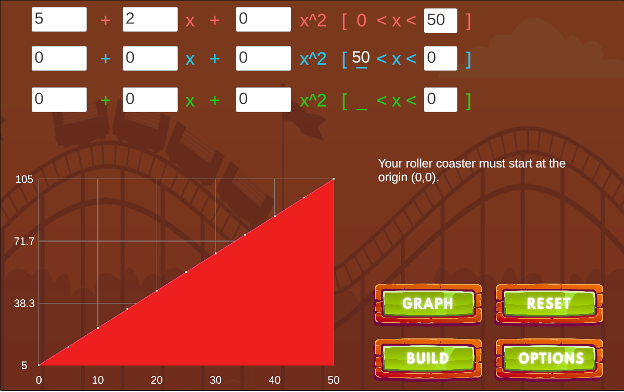
Where a represents the initial value/y-intercept and b represents the slope/rate of change of our linear function (i.e. a line). For example, try entering the function f(x) = 5 + 2x.
Entering equations:
We can leave 0's in places we don't need them, like the x² term in this example.
One of the requirements of the game is that the domain of the coaster goes from x = 0 to x = 50, we have to indicate that on the right hand side of the equation (in the notation of a piecewise-defined function).
Click the "Graph" button after entering the equation to see the graph that we would (hopefully!) expect for this function.
You will receive a message indicating that the equation violates one of the game rules.
To ensure we start our coaster at the point (0, 0), change the linear equation to f(x) = 0 + x. Click the "Build" button and let's see our coaster go!
Notice that while our roller coaster works, our thrill score = 0. Maybe that's because a roller coaster would be boring if it never went down a hill.
We can enter two linear equations, so that the coaster will go up and down. For example, try the following two equations:
f(x) = 0 + 2x + 0x² for 0 < x < 25
You should receive an error message for these two functions, indicating that we have a problem with continuity and/or differentiability at x = 25.
Continuity means there are no breaks in our track, and differentiability implies that the track flows smoothly without any sharp turns or discontinuities.
Do you think continuity or differentiability is causing a problem with this track?
Part 1D: Exploring Quadratic Coasters
The simplest way to build a continuous and differentiable coaster is to use a single quadratic function. You'll recall that a quadratic function has the algebraic form
f(x) = c + bx + ax².
Enter the following function into the coaster game. Here we can see that the coaster design is both continuous and differentiable (smooth):
f(x) = 0 + 2x - 0.04x² for 0 < x < 50
Modify the quadratic function in Question 6 to produce a higher score.
How high of a score can you get?
What feature(s) of a quadratic function might you want to take into consideration?